

Choosing a professional painter for home interiors involves more than comparing colours and prices when you are still living in the house. You need to know which rooms will remain usable, how preparation dust will be controlled and what condition the property will be left in each evening.
Look for a detailed quote and a practical occupied-home work plan. A painter should explain both the finished result and the process of getting there, including access, protection, ventilation and changes to the schedule. Those details help you decide whether staying home will be manageable.
Start with the rooms you cannot do without
Before arranging site visits, write down how your household uses the property. A spare bedroom might be available for several days, but your only bathroom, kitchen or work-from-home space needs a different plan.
Tell prospective painters about school routines, shift work, scheduled meetings and anyone who sleeps during the day. Identify essential routes through the house, particularly between bedrooms, bathrooms and exits. These conversations should happen before the quote is finalised, not when furniture is already covered.
Decide where movable belongings can go without creating another problem. Packing everything into a hallway may free up a bedroom but obstruct the route you need to use safely.
Your brief does not need to prescribe the painter’s methods. It should make your non-negotiable household needs clear enough for them to propose a workable sequence.
Can a professional painter for home interiors work around your routine?
Often, yes, but ask for evidence rather than accepting “we’ll work around you” as the whole answer. A painter experienced in occupied homes should be able to describe a previous project with similar access constraints.
Ask a recent customer whether rooms were handed back when expected, belongings stayed protected and schedule changes were communicated promptly. Reviews about a beautiful finish are useful, but they do not tell you whether the household could function during the work.
Reassurance matters in personal services, whether you are choosing a family dental practice or inviting a tradesperson into private rooms. For painting, that reassurance should translate into specific arrangements for privacy, noise and access.
Discuss whether rooms can be completed in groups rather than opening the whole house at once. Our guide to booking house painting in stages explains the trade-off between household convenience and repeated setup. Ask how the proposed sequence affects both the price and completion date.
Compare the disruption included in each quote
A professional painter for home projects should price the actual conditions of your job, including the fact that people and belongings will remain on site. A cheaper quote may assume empty rooms, uninterrupted access or furniture moving that you have not agreed to do.
Use the same written brief for each site visit, then compare these details:
| Quote item | What should be clear |
|---|---|
| Surfaces | Which walls, ceilings, doors, frames and trims are included |
| Preparation | Cleaning, patching, sanding, priming and the limits of repairs |
| Coating system | Named products, primers and specified coats for each surface |
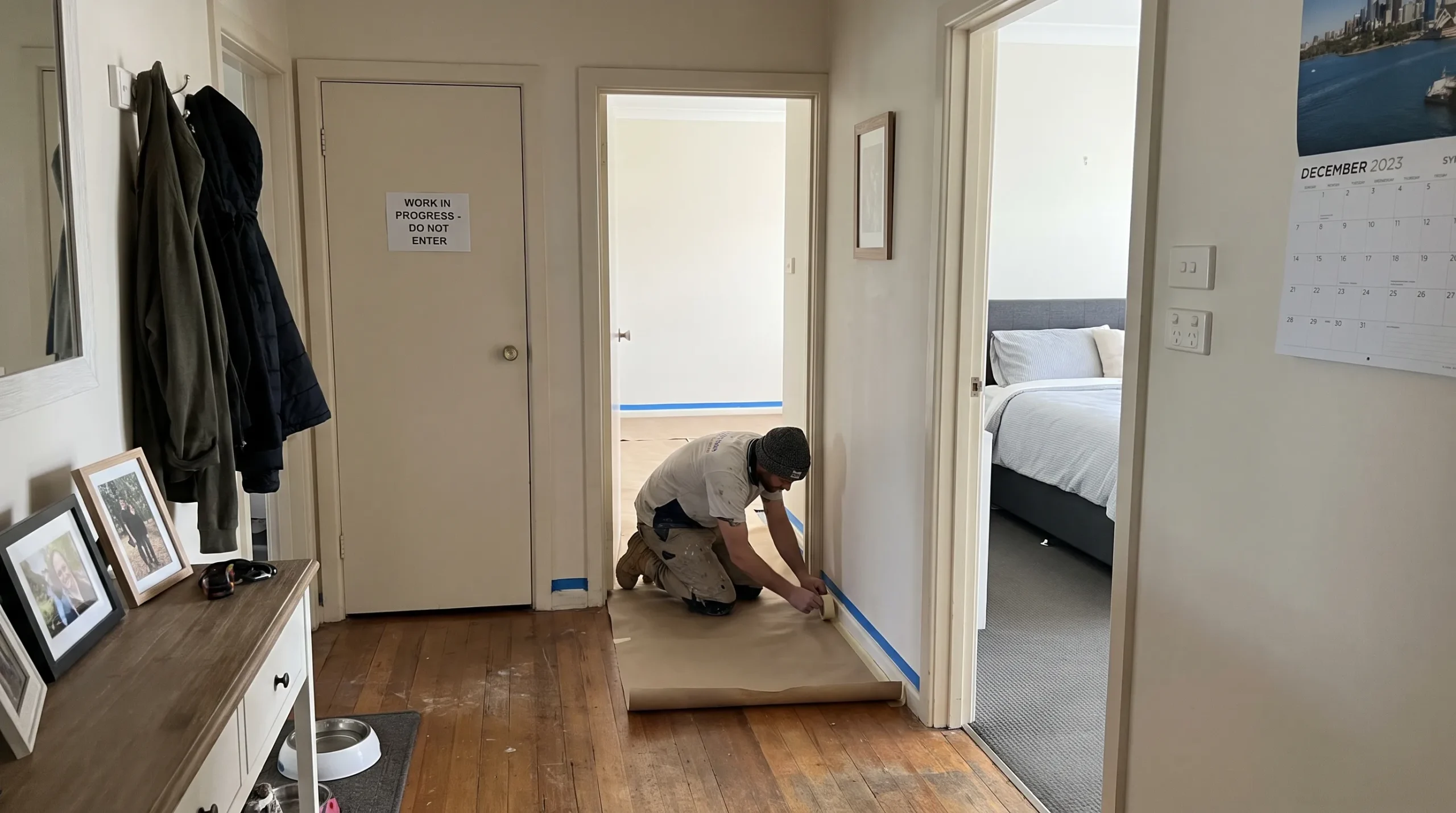
| Protection | Floor coverings, furniture protection and dust-control arrangements |
| Household tasks | Who moves furniture, removes curtains and reinstates belongings |
| Daily handover | Which spaces remain accessible and what clean-up is included |
| Exclusions | Hidden damage, specialist remediation and work requiring a separate price |
Avoid treating “premium paint” or “full preparation” as a complete specification. Ask what those descriptions mean for your surfaces.
The total should also make clear whether GST is included and whether occupied-home staging has been allowed for. If one proposal differs substantially, ask the painter to explain the scope difference before negotiating the price.
Verify credentials and record the agreement
When engaging a professional painter for home repainting, check the business identity and request a current public liability insurance certificate. Confirm that the insured name matches the business you are hiring and ask who will actually carry out the work, including any subcontractors.
Do not assume an ABN, trade association membership or manufacturer accreditation is a government licence. Requirements differ between states and by the work involved. For Melbourne projects, Consumer Affairs Victoria’s building and renovating guidance is a useful starting point for checking applicable contract and registration requirements, especially where repairs extend beyond painting.
Record the agreed scope, price, payment stages and anticipated timing in writing. The agreement should explain how variations are approved, including their effect on cost and room availability. Ask for approval before additional work starts, rather than accepting an unexplained extra charge afterwards.
Read the workmanship warranty too. Establish what it covers, any exclusions and how to report a problem. A workmanship warranty is different from a paint manufacturer’s product warranty, and neither should be treated as a substitute for your statutory rights.
Agree on access, privacy and the daily handover
A professional painter for home interiors needs access to work efficiently, but that does not mean unrestricted access to every room. Agree on arrival times, key handling, alarm arrangements and which spaces are out of bounds.
Choose one person on each side to handle decisions. This reduces conflicting instructions and gives you a clear contact if a room cannot be handed back as planned. Ask how much notice you will receive before noisy preparation or a temporary access restriction.
The end-of-day arrangement should cover practical checks:
- Essential access: Agreed routes to usable rooms and exits remain clear.
- Equipment and materials: Tools, coatings and waste are secured away from occupants.
- Work-area condition: Dust and debris are managed using appropriate methods, with no loose coverings creating trip hazards.
- Next-day notice: You know which room is next and what needs moving before work resumes.
“Cleaned up” does not necessarily mean “ready to occupy”. Establish whether a room is merely tidy, safe to walk through or suitable for its normal use. Those are different handover conditions.
Discuss paint, preparation and room reoccupation
Ask for the proposed paint products before work starts, particularly if anyone has asthma, sensitivities or another condition that could affect their ability to remain at home. Seek medical advice where appropriate and give the painter relevant practical restrictions without expecting them to provide health advice.
Low-odour and low-VOC descriptions do not mean a room can be occupied immediately. Ventilation, drying, recoating and curing requirements depend on the product and conditions. Follow the manufacturer’s guidance and agree on a reoccupation plan, especially for bedrooms. Touch-dry paint is not necessarily fully cured or ready for cleaning and normal wear.
Preparation deserves equal attention. Ask how sanding dust will be contained and how work areas will be separated from living spaces. If old coatings may contain lead, or preparation could disturb suspected asbestos-containing material, arrange assessment before that work proceeds. Do not accept routine sanding as the default response to an unidentified hazard.
Households with children or animals also need secure separation, not just a warning to avoid wet paint. Our guide to planning painting work around children and pets covers those additional arrangements.
Know when staying elsewhere is more practical
Staying home should remain a choice, not a condition you feel obliged to endure. Temporary accommodation may be the better option if the work removes access to your only bathroom, blocks essential routes or leaves no suitable sleeping area.
The same applies when preparation requires controls that cannot be maintained alongside normal household activity. Ask the painter to explain the constraint and whether changing the sequence would genuinely solve it.
A professional painter for home renovations should be willing to discuss those limits rather than promise that every project can proceed comfortably around occupants. Sometimes a short period away allows an awkward section of work to be completed with less overall disruption.
If you do leave temporarily, confirm how access, security and progress updates will work. Agree on the conditions for returning, rather than relying on a fixed number of hours that may not suit the products, weather or ventilation available.
Inspect the finish before the project closes
Arrange a final walkthrough when the work can be properly inspected, rather than trying to assess it while furniture is being moved back. Compare the completed surfaces with the written scope and check that agreed doors, trims and other details have not been missed.
Look for visible coverage problems, drips, paint on fittings and damage to adjacent surfaces. Assess the work under normal lighting and viewing conditions, and discuss concerns against the agreed finish rather than expecting paint to conceal structural movement or excluded repairs.
A professional painter for home projects should explain how any agreed touch-ups will be completed and what access they require. Record outstanding items, responsibilities and dates in writing.
Before closing out the job, request product names, colour details and care instructions. Confirm any leftover paint is labelled and stored appropriately, and follow the agreed payment terms while documenting unresolved concerns.
Frequently asked questions
Is it worth paying a painter if I am staying home during the work? Professional help can be worthwhile for surface preparation, application and coordinating work around an occupied household. The value depends on the agreed service, so check that protection, sequencing and daily clean-up are actually included.
How much does it cost to paint a three-bedroom house in Melbourne? Bedroom count alone is not enough for a reliable quote. Surface condition, ceiling height, trims, colour changes, repairs and occupied-home access all affect the work. Seek inspected, itemised quotes based on the same scope rather than comparing whole-house figures with different inclusions.
Should I compare hourly rates or a fixed project price? A fixed price makes a defined scope easier to compare. An hourly arrangement needs clear rates, material charges, an estimate and a process for approving further time. When comparing a professional painter for home interiors, focus on the total scope and responsibilities, not just the headline rate.
Can I sleep in a bedroom painted that day? Do not assume so. Suitability depends on the coating, application conditions, ventilation and the occupant’s circumstances. Discuss sleeping arrangements before work starts and follow product guidance and any relevant medical advice.
Discuss your occupied-home painting plans
Auspainters provides residential painting across Melbourne, with free quotations, Dulux accreditation, full insurance and a five-year workmanship warranty.
When enquiring about interior house painting, explain that you will remain in the property and identify the rooms you need each day. Ask for the proposed sequence, protection arrangements, written scope and warranty terms so you can assess the finish and the experience of living through the work.