

A commercial painting estimate based only on floor area can miss much of the work that determines the final price. A 200 m² open-plan office and a 200 m² tenancy divided into consulting rooms have the same footprint, but very different amounts of wall surface, cutting-in, preparation and disruption to manage.
For Melbourne property owners, tenants and facilities managers, floor area is a starting point for a budget, not a complete basis for appointing a painter. A useful estimate connects measured surfaces with their condition, the specified coating system and the practical requirements of working in your building.
Why floor area gives an incomplete cost picture
Floor area describes the space beneath your feet. Painters need to assess the surfaces they will actually prepare and coat, including walls, ceilings, doors, frames, columns and other specified elements.
The relationship between these quantities changes considerably between buildings. High ceilings increase wall area without changing the footprint. Meeting rooms create additional wall faces. Glazing can reduce painted wall area while adding masking and careful edge work.
Even identical surface quantities can require different budgets. Sound plasterboard with straightforward access is not equivalent to peeling masonry above a busy entrance.
A square-metre price is only meaningful when its measurement basis and included work are clear. Before comparing rates, establish whether the denominator is floor area, paintable surface area or something else entirely.
Measuring the surfaces behind a commercial painting estimate
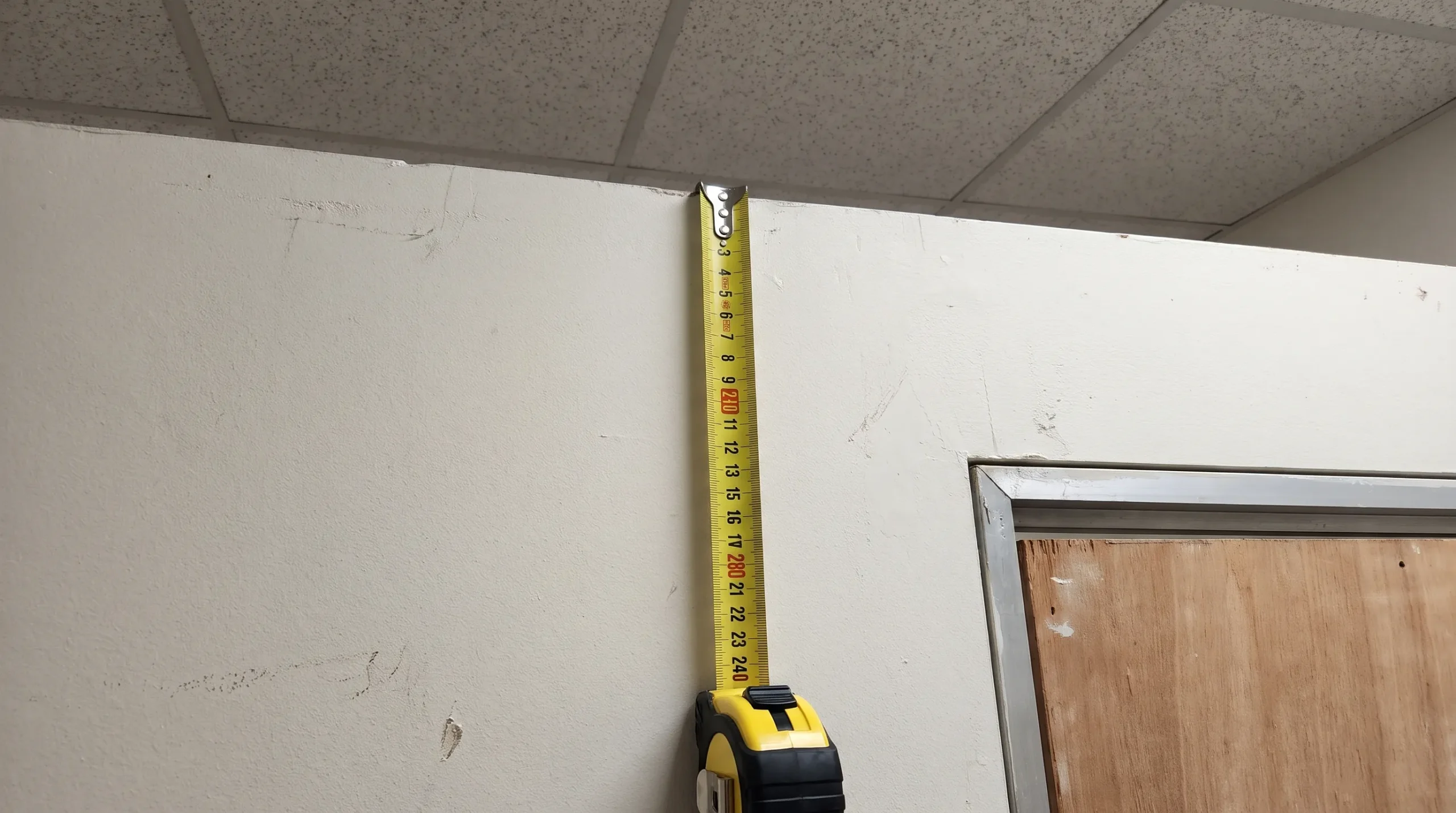
For a straightforward rectangular wall, multiply its length by its height. Repeat this for every wall face included in the scope, then account for openings using an agreed measurement approach.
Internal partitions need particular attention. A partition painted on both sides contributes two painted faces, not one. Columns, bulkheads, stairwells and changes in ceiling height also need separate measurement.
Ceilings should be measured independently. A flat ceiling may match the room’s floor area, but sloping surfaces, exposed beams and services can change both the quantity and the application method.
Doors and frames are often clearer as counted items rather than small additions to a wall-area total. Their preparation, edges and detailed brushwork do not behave like an uninterrupted wall.
Worked example: a 200 m² office
Consider a hypothetical office measuring 20 metres by 10 metres, with a uniform ceiling height of 2.7 metres. It also contains 24 linear metres of internal partitions, all painted on both sides.
| Measurement | Calculation | Quantity |
|---|---|---|
| Floor area | 20 × 10 | 200 m² |
| Perimeter wall faces | 60 × 2.7 | 162 m² |
| Internal partition faces | 24 × 2 × 2.7 | 129.6 m² |
| Gross wall area | 162 + 129.6 | 291.6 m² |
| Agreed opening deductions across painted faces | Measured separately | 14 m² |
| Net wall area | 291.6 − 14 | 277.6 m² |
| Flat ceiling | 20 × 10 | 200 m² |
| Total walls and ceiling | 277.6 + 200 | 477.6 m² |
The commercial painting estimate now has approximately 478 m² of wall and ceiling surface to address, rather than simply 200 m² of floor space. Door leaves, frames and other detailed items remain separate.
Opening deductions also need context. A small window reduces coating area but creates edges to mask and cut around. Agree whether small openings are deducted and whether reveals are included, rather than assuming every contractor measures identically.
How painters turn quantities into prices
Commercial work can be priced using surface-area rates, labour allowances, itemised quantities or a fixed price for a defined scope. Many estimates combine these methods.
A wall-painting rate might cover preparation and application to a specified substrate, while doors are priced individually and elevated access is listed separately. Another contractor may consolidate the same work into one fixed amount.
Neither presentation is automatically better. The important question is whether both prices describe the same outcome and allocation of risk.
A useful estimating framework is:
Preparation labour + application labour + materials + access and protection + project-specific costs.
Contractors must also account for business overheads and margin. These may be incorporated into their rates rather than disclosed as separate lines.
When reviewing a commercial painting estimate, ask what each rate includes before dividing the total by your floor area. An apparent rate difference may reflect different preparation standards, omitted ceilings or different working hours, not a genuine difference in value. A floor-area rate can help benchmark similar completed projects, but it should not replace a measured scope for a new site.
Surface preparation changes the labour allowance
Preparation is one of the strongest reasons two similarly sized premises can cost different amounts to repaint.
An occupied office with sound paint may require cleaning, minor filling and spot priming. A previously damp storeroom may need investigation, repairs and drying before coating can begin. Paint does not correct the source of water entry or stabilise a failing substrate by itself.
The estimate should distinguish routine preparation from substantial remedial work. “Prepare as required” leaves too much room for disagreement if nobody has defined the existing condition.
Photographs and marked-up plans help establish what was visible during inspection. Accessible test patches can also help a contractor assess adhesion and compatibility, where appropriate.
For a commercial painting estimate to remain dependable, assumptions about hidden surfaces must be explicit. Walls behind fixed shelving, for example, cannot be assessed as confidently as exposed walls. The document should explain whether those areas are excluded, provisionally allowed for or subject to inspection after the shelving is removed.
Do not confuse cosmetic filling with building repairs. Widespread cracking, loose render and recurring moisture may need investigation by an appropriate trade before the painting scope can be finalised.
Paint specification affects both quantities and application
“Two coats of paint” is not a complete specification. The substrate, existing coating, primer requirements, product type and intended finish all influence the work.
High-contact corridors may need a different coating system from a low-traffic meeting room. Bare metal, masonry and previously painted plasterboard also require different preparation and compatible products.
Colour changes matter too. Achieving an even finish when moving between strongly contrasting colours may require a different approach from refreshing an existing shade. Coverage should follow the selected product’s technical guidance and the actual substrate condition, not an assumption that every finish will cover equally.
As a quantity exercise, 478 m² receiving two coats at an illustrative spreading rate of 12 m² per litre would require about 80 litres of topcoat before wastage or site allowances. That is not a product recommendation or purchase quantity: actual coverage, primers and application losses must be checked separately.
A commercial painting estimate should therefore identify the coating system, not merely a brand name. This makes substitutions and price comparisons much easier to evaluate.
Access and working hours can outweigh small area differences
A wall above a reception desk is not priced like the same wall in an empty room. Furniture protection, restricted movement and repeated setup can reduce productive painting time without adding a single square metre.
High-level work may require scaffold, mobile platforms or an elevated work platform, depending on the task and risk assessment. Equipment delivery, suitable access routes and floor-loading constraints can affect feasibility as well as cost.
Outside, a footpath, neighbouring property or public entrance may introduce additional coordination and approval requirements. Weather can also change the practical sequence of exterior work in Melbourne.
Scheduling deserves its own discussion. An empty tenancy available during normal hours differs from an operating business that can release only two rooms each evening. Repeated mobilisation, securing work areas and reinstating rooms for the next business day all require time.
Ask whether the proposed programme includes coating drying and recoat requirements, ventilation and any restrictions on reoccupation. “After hours” describes a time window, not a guarantee that every coating system can be applied and returned to service overnight.
Different premises create different estimating priorities
The type of business helps reveal work that measurements alone cannot capture. Offices often require staged access around staff, shops need stock protection and warehouses may combine large simple surfaces with difficult high-level access.
For a commercial painting estimate covering a healthcare or food-related setting, the contractor also needs to understand the site’s cleaning, isolation and operational requirements. A particular coating should not be assumed suitable simply because it is marketed for commercial use.
Premium retail introduces another set of considerations. A business showcasing detailed products, such as Raphana Jewellery’s diamond engagement rings, illustrates why wall colour, display lighting and the protection of valuable stock deserve attention during planning. This is a retail example, not a claim about painting work undertaken for that business.
In such a setting, approving a sample under the actual display lighting may prevent an expensive colour change later. Removing stock and securing display cases should also have a named responsible party.
For a lease make-good, the starting point is different again: confirm the agreed reinstatement obligations before measuring. Painting every surface is not automatically necessary, nor should a contractor’s estimate be treated as an interpretation of the lease.
An illustrative estimate with separate cost allowances
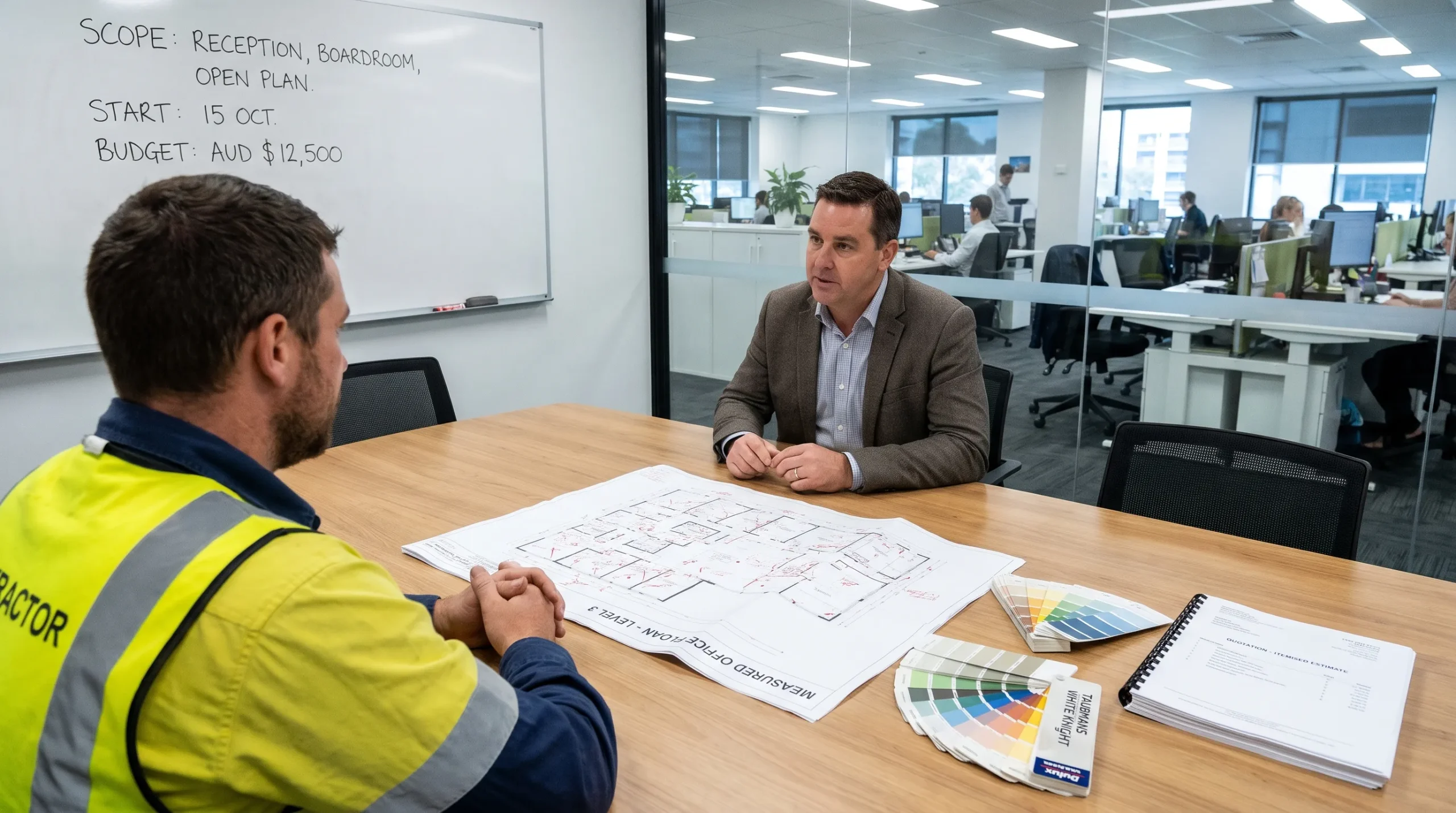
The following example uses the approximately 478 m² office measured earlier. It assumes sound existing plasterboard, limited patching, one daytime mobilisation and unobstructed access after furniture has been moved.
These are invented figures for explaining estimate structure, not Auspainters pricing or a Melbourne market-rate guide. All amounts are Australian dollars.
| Cost component | Illustrative basis | Amount excluding GST |
|---|---|---|
| Routine preparation | 32 labour hours × $70 | $2,240 |
| Coating application | 64 labour hours × $70 | $4,480 |
| Paint and application consumables | Defined materials allowance | $1,450 |
| Access equipment | Suitable equipment allowance | $450 |
| Protection and mobilisation | Separate setup allowance | $650 |
| Final clean and handover | Completion allowance | $300 |
| Subtotal | $9,570 | |
| GST | 10% | $957 |
| Total including GST | $10,527 |
The labour categories are separated to avoid counting preparation twice. Protection, mobilisation and final cleaning are also outside the stated preparation and application hours.
This example excludes doors, frames, major repairs, hazardous-material work and after-hours attendance. The 96 preparation and application hours are labour hours, not a promise about elapsed project duration.
Make uncertainty visible before approving the work
An estimate becomes less useful when unknowns are hidden inside optimistic assumptions. Identify the uncertainty and decide how it will be managed before work starts.
Suspected hazardous materials need particular care. Older coatings may contain lead and some building materials may contain asbestos. Do not authorise sanding, scraping or other disturbance of suspect material before the necessary assessment. WorkSafe Victoria provides guidance on workplace risks and hazardous materials.
Other uncertainties are more routine: damaged plaster behind cabinets, corrosion beneath loose paint or previously inaccessible external surfaces. These still need a decision process.
A commercial painting estimate can address uncertainty through clearly defined exclusions, provisional allowances or agreed rates for specific additional work. Each approach should explain what triggers a price adjustment and who can approve it.
Keep a client contingency separate from the contractor’s contract price. It is a budget reserve, not automatic permission to spend. If additional work is identified, request photographs, a description, the price and any programme impact before giving written approval.
Operational disruption belongs in this discussion too. Lost access to treatment rooms, loading areas or trading space can matter more to a business than a modest difference between painting prices.
Compare the same scope before comparing totals
When competing estimates arrive, transfer their inclusions into a simple comparison sheet. Check measured surfaces, preparation, coating systems, working hours, access and exclusions against the same brief.
Do not silently fill gaps in the cheapest offer. If one price includes ceilings and another does not mention them, request clarification rather than assuming equivalence. The same applies to furniture movement, removal of fittings and reinstatement.
Where quantities differ, ask contractors to explain their measurement method. One may have counted both partition faces while another worked from floor area alone. You do not need identical estimating software, but you do need an intelligible basis for the difference.
Our guide to what Melbourne commercial painting prices include explores the scope details worth checking in written offers.
Before accepting a commercial painting estimate, also establish whether it is a preliminary budget or an offer to complete defined work for a stated price. Ask about validity, GST, payment stages and the process for variations. Do not rely on the document’s title alone to understand its contractual effect.
Check the contractor’s ability to deliver the scope
A detailed estimate still needs a capable contractor behind it. Confirm relevant experience, current insurance and how the proposed access and work methods will be managed safely.
Ask who will supervise the job, how occupied areas will be separated from work zones and how defects will be recorded at completion. Where high-risk construction work is involved, the required safety documentation and controls must be addressed.
A warranty also needs context. Understand what workmanship cover includes, its conditions and how it differs from product warranties or problems caused by underlying building defects. Accreditation is useful information, but it does not replace a site-specific scope.
For a broader assessment, our guide to comparing commercial painting companies in Melbourne explains how to look beyond the headline price.
Agree on completion criteria before work begins. A final walkthrough is more productive when both parties already understand the approved colours, painted surfaces and expected finish.
Frequently asked questions
What do commercial painters charge per square metre? There is no single rate that meaningfully covers every building. Ask whether the rate refers to floor area or painted surface area, then check preparation, coatings, access and working hours. A rate without that scope is not a reliable comparison.
Can I get a commercial painting estimate from plans? Plans can support an initial budget, particularly when dimensions and finishes are documented. Existing buildings usually need a site inspection to assess surface condition, access, occupancy and other factors that drawings do not reliably show.
Should windows and doors be deducted from wall measurements? The measurement method should be agreed. Large openings may be deducted, while small openings can involve enough edge work to offset some area savings. Door leaves, frames and reveals should be explicitly included or excluded.
Does an estimate include repairs and unexpected work? Only to the extent stated in its scope and allowances. Ask which repairs are included and how concealed damage will be assessed, priced and approved. Additional work should not proceed on an undefined assumption that the client will pay later.
Request a site-based assessment in Melbourne
Auspainters provides residential and commercial painting across Melbourne, with free quotations, Dulux accreditation, full insurance, OHS-compliant work practices and a 5-year workmanship warranty. A final walkthrough forms part of its service.
To help prepare an accurate scope, have your plans, access restrictions, preferred working hours and known repair issues ready. Contact Auspainters to discuss your premises and arrange a quotation based on the work required, not just the size of the floor.