

A commercial repaint does not have to mean closing the entire premises, but keeping a business operating takes more than booking painters for the weekend. Experienced commercial paint contractors reduce downtime by planning access, separating work areas and agreeing on when each space can safely reopen. For Melbourne business owners and facilities managers, the goal is straightforward: improve the property without unnecessary interruptions to customers, staff or deliveries.
The most useful conversation starts with your operating requirements, not a paint colour. Trading hours, essential access routes and the way people use each room should shape the project schedule from the outset.
Start with an operational brief, not just a floor plan
Before quoting, a contractor needs to understand what your business cannot afford to lose access to. A reception desk might need to remain staffed throughout the day, while a meeting room could be unavailable for several days without affecting service.
Identify your busiest periods, delivery windows and any processes that cannot be interrupted. Include cleaning schedules, security arrangements and building-management requirements. In a shared Melbourne office building, access to loading bays or goods lifts may need advance approval.
Commercial paint contractors can then build the work sequence around these constraints rather than asking your team to adapt once painting begins. A useful brief records:
- Areas that must remain accessible during operating hours
- Quiet periods suitable for disruptive preparation
- Approved access times and arrangements for keys or security
- Equipment, stock and furniture that require protection or relocation
- Who can approve changes and accept completed areas
Make sure these requirements appear in the written scope. When comparing commercial painting companies in Melbourne, assess the proposed access and handover plan alongside preparation, finishes and price.
How commercial paint contractors phase an occupied site
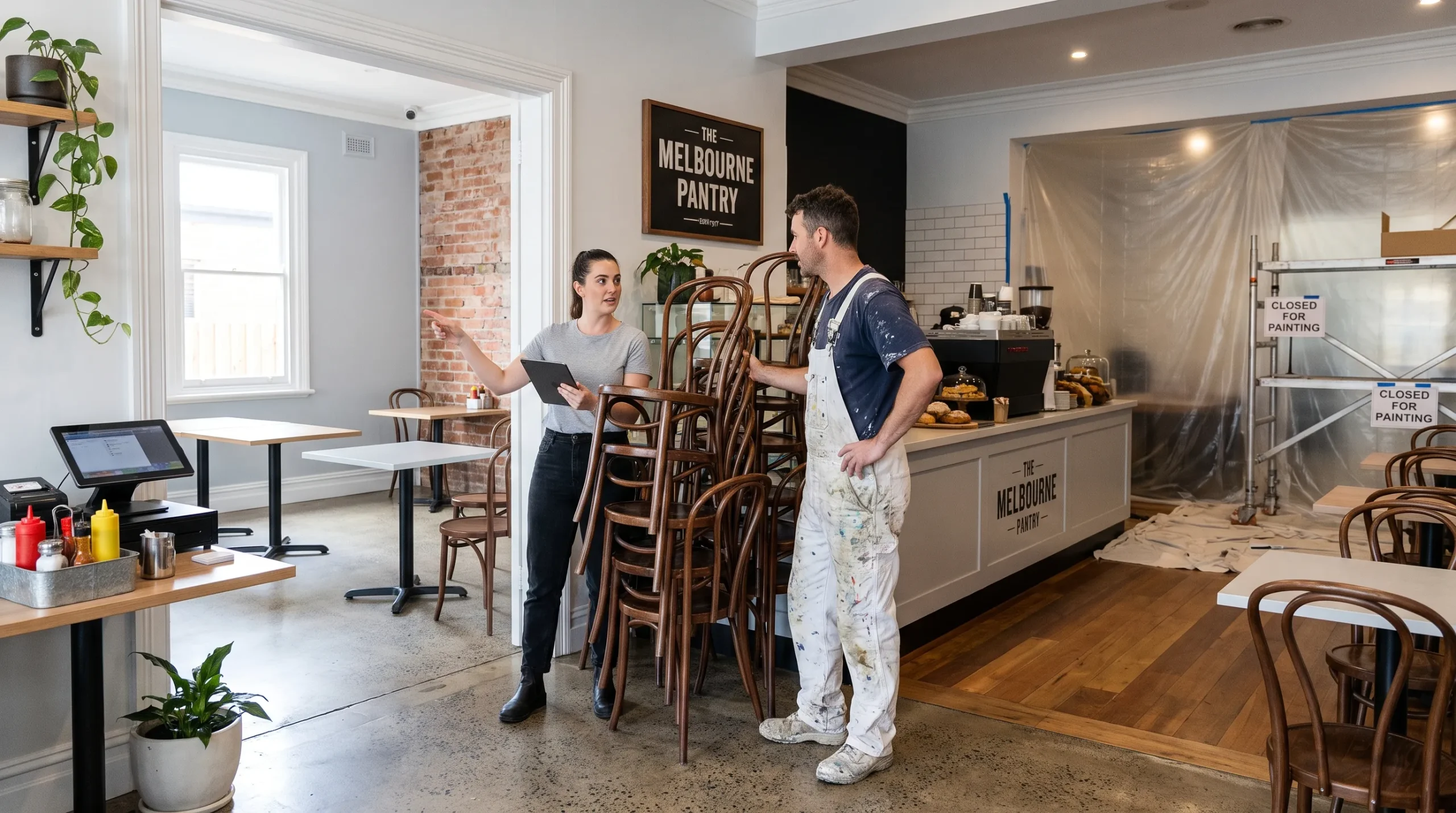
Dividing the premises into manageable zones often avoids a full shutdown. Instead of opening every room for preparation at once, the team completes a defined area, checks it and releases it before moving to the next.
The boundaries need to reflect how the business operates. Painting half a corridor is not helpful if the remaining half cannot provide safe access. Similarly, a retail zone should not block the checkout, accessible entrance or stock replenishment route.
| Business setting | Possible staging approach | Operational issue to resolve first |
|---|---|---|
| Office | Complete meeting rooms before shared work areas | Temporary seating and access to essential equipment |
| Retail premises | Work through separate display zones | Customer circulation and protection of merchandise |
| Warehouse | Separate administrative areas from operational zones | Vehicle movements, deliveries and storage access |
| Hospitality venue | Stage dining areas and back-of-house spaces separately | Food protection, cleaning and service requirements |
These are planning options, not promises that every site can remain open. Commercial paint contractors should confirm whether the proposed separation is practical before committing to it. Where safe isolation is impossible, a short planned closure may be less disruptive than several days of restricted operations.
Make after-hours work practical
Evening, overnight or weekend painting can move disruptive work outside trading hours. However, an after-hours booking only helps if the building is accessible and there is enough time for preparation, coating, ventilation and clean-up.
Confirm who will unlock the premises, whether alarms need authorised management and how the crew will leave the site secure. Lighting, toilets and approved ventilation must also be available. In multi-tenancy buildings, noisy preparation may still be restricted outside ordinary office hours.
Avoid treating a weekend as a guaranteed completion window. Damaged surfaces, multiple coats or unsuitable environmental conditions can extend the programme. Ask which tasks are scheduled for each shift and what happens if an area is not ready by opening time.
Commercial paint contractors minimise disruption more effectively when they coordinate with cleaners, maintenance teams and other trades. A floor-cleaning crew arriving while coatings are still vulnerable can undo progress, while a late furniture delivery may prevent access to unfinished walls. One shared schedule helps avoid both problems.
Keep customers and staff separate from the work
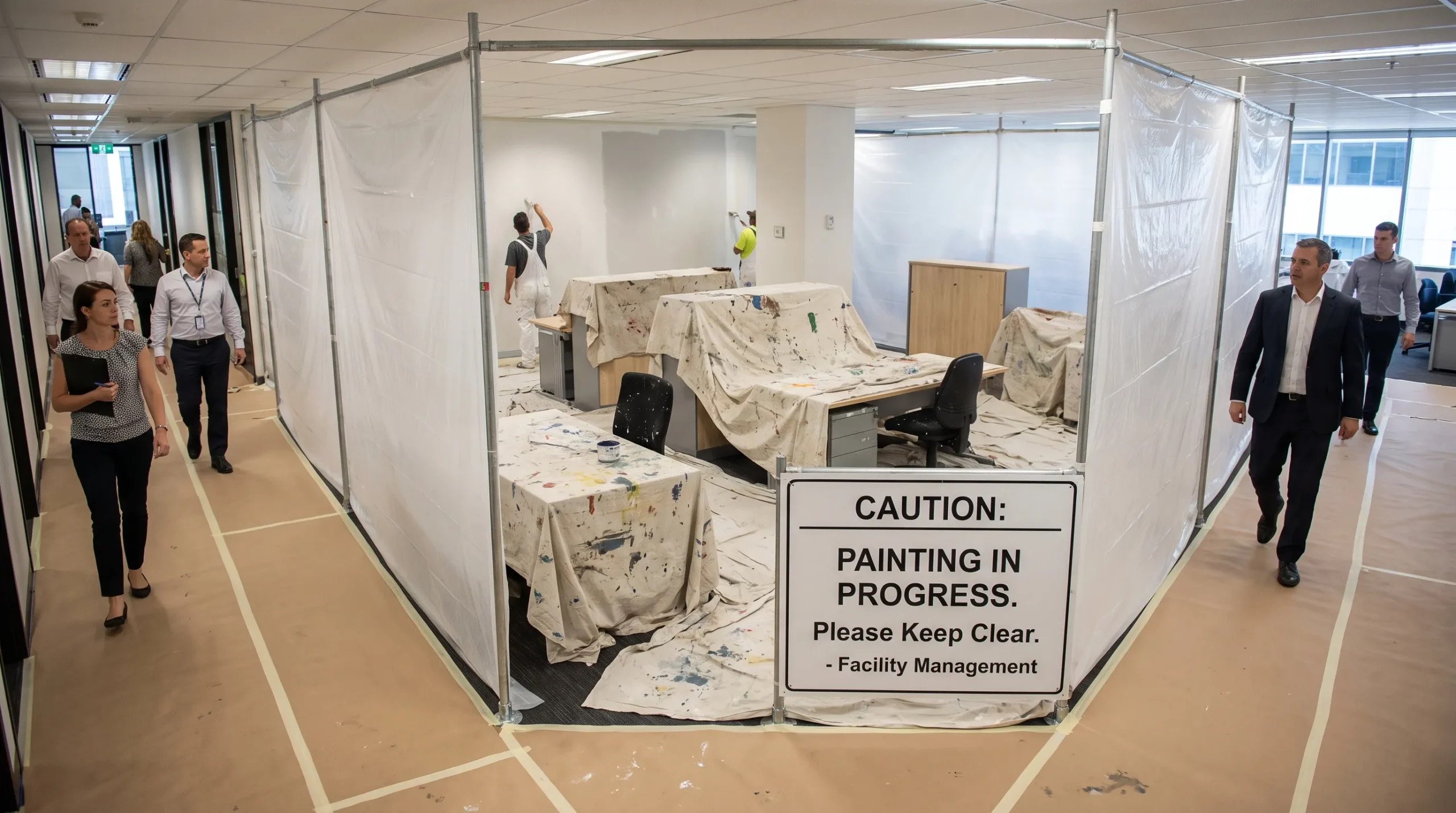
An occupied site needs a clear distinction between business activity and painting activity. Protective coverings alone do not address dust, equipment, trailing leads or customer access.
The contractor and site manager should agree on barriers, signage and material-storage locations. Emergency exits and required accessible routes must remain available. Where the planned work affects these routes, resolve the access arrangement before starting rather than improvising around it.
Dust-producing preparation deserves particular attention. Sanding beside occupied desks or exposed merchandise can create cleaning work and disruption well beyond the painted area. Isolation, suitable dust controls and cleaning should be built into the programme. Ventilation arrangements also need to avoid transferring dust or vapours into occupied spaces.
On older premises, suspected hazardous materials or deteriorated coatings may require assessment before disturbance. That can change the scope and schedule, so an early inspection matters.
Responsible commercial paint contractors account for these controls when estimating the job. Compressing the schedule by removing necessary protection is not a genuine reduction in downtime.
Separate drying time from safe reopening
A wall that feels dry is not necessarily ready for normal business use. Three different coating milestones matter:
- Touch-dry: The surface has dried enough to resist light contact under the stated conditions.
- Recoat-ready: Another coat can be applied according to the product instructions.
- Fully cured: The coating has developed its intended properties, including its specified resistance to wear and cleaning.
These stages are not interchangeable. Reopening may be possible before full cure, provided the area is suitable for occupancy and the new finish can be protected. However, moving furniture against fresh paint or washing it too soon can damage the surface and trigger another visit.
The schedule should follow the selected coating’s technical data sheet, safety data sheet and actual site conditions. Temperature, humidity and ventilation can affect drying. Low-VOC products may be suitable for some occupied environments, but that label alone does not establish a safe reopening time. Smell is not a reliable safety test either.
Commercial paint contractors should explain both the handover conditions and any restrictions that continue afterwards. Your team needs to know when desks can return, when signage can be refitted and when cleaning can resume, not simply when the last coat will be applied.
Prevent repeat disruption through proper preparation
Skipping preparation can make the initial programme look shorter while increasing the chance of corrective work later. Loose paint, contamination, unresolved moisture or poorly repaired damage can compromise the finish.
The inspection should identify repairs and separate straightforward surface preparation from problems that need another trade. For example, painting over a continuing leak does not resolve its cause. Organising the repair first can prevent a second closure to redo the same wall.
A home-focused guide to professional painting and wallpapering also highlights careful workmanship and durable results. In commercial premises, those priorities have an additional operational benefit: reducing avoidable rework after staff and customers return.
Where colours or finishes are uncertain, approve a sample before the main application. Commercial paint contractors can use that decision to avoid repainting a completed area because its appearance differs from what the client expected. Allow for the sample approval in the schedule rather than leaving it until the crew is ready to proceed.
Agree on a daily handover process
Downtime is easier to manage when the business knows exactly what has been completed and what remains unavailable. A brief daily update should identify the finished zone, the next work area and any change to access or reopening arrangements.
Nominate one contact for the business and one for the painting team. This avoids conflicting instructions from different departments and gives the crew a clear route for reporting unexpected repairs or access problems.
At each staged handover, check more than the appearance of the paint. Confirm that equipment and waste have been removed, agreed cleaning is complete and access routes are clear. Record any restrictions on touching, cleaning or refitting items to the new finish.
Commercial paint contractors should also have a process for minor defects that does not unnecessarily reopen an entire work zone. Where practical, identify touch-ups before furniture returns and arrange any remaining corrections within an agreed access window.
The final walkthrough closes the project, but it should not be the first time the client sees completed work. Progressive checks help catch misunderstandings while they are still straightforward to resolve.
Build a contingency into the programme
For exterior work in Melbourne, weather can change the sequence even when indoor business activity continues. Rain, unsuitable temperatures or damp surfaces may prevent coating application. Scaffold or access-equipment arrangements can also affect entrances, parking and deliveries.
Ask which indoor tasks can proceed if exterior work is delayed. The answer should be based on the actual scope, not an assumption that the team can always switch areas.
Unexpected substrate damage and delayed approvals need a response plan too. Agree on who authorises additional work, how it will be priced and how any schedule change will be communicated.
Commercial paint contractors cannot remove every uncertainty, but they can distinguish a target completion date from the conditions needed to achieve it. A realistic programme with a fallback arrangement is more useful than an unconditional promise of zero disruption.
Frequently asked questions
Can my business stay open during painting? Often, parts of the premises can remain open if work areas can be safely separated and essential access maintained. Some tasks or site layouts require temporary closure. Confirm the arrangement after a site inspection, not from a general assurance.
Is weekend painting always the least disruptive option? No. Weekend work may suit your trading hours, but access restrictions, noise rules and coating requirements still apply. Staged weekday work can be more practical where unused rooms or separate zones are available.
What should I ask about reopening? Ask commercial paint contractors what conditions must be met before occupancy, what protection the new coating needs and when normal cleaning or furniture placement can resume. Get these instructions for each area rather than relying on a single project-wide date.
Does faster-drying paint guarantee less downtime? No. Preparation, access, ventilation and the number of coats also influence the programme. The product must suit the surface and use of the space, with application and reopening based on its instructions and site conditions.
Request a quote around your business schedule
Auspainters provides residential and commercial painting across Melbourne, with free quotations, Dulux accreditation, full insurance and OHS-compliant work practices. Its services include a final walkthrough and a 5-year workmanship warranty.
When you request a commercial painting quote from Auspainters, share your trading hours, essential access requirements and preferred completion window. Ask which staging and scheduling options suit your premises, and have the agreed arrangements recorded in the scope. That gives your business a clearer plan for staying operational while the work proceeds.