


A professional painter’s warranty should explain what happens if the finish fails because the work was not carried out correctly. It should identify the work covered, the warranty period, any exclusions and who pays to put an accepted defect right. A promise of “five years” is useful, but it is not enough on its own.
For Melbourne homeowners and commercial property managers, the practical test is straightforward: can you understand what is covered and how to request a repair before you accept the quote? Here is what to look for in the written terms.
Separate workmanship, paint products and consumer rights
Three different forms of protection can apply to a painting job. They should not be treated as interchangeable.
A workmanship warranty is the contractor’s promise about the quality of their work. Depending on its wording, it may address failures caused by inadequate preparation, unsuitable application or failure to follow the agreed coating system.
A paint manufacturer’s warranty concerns the product and its stated performance under specified conditions. It does not automatically cover poor preparation or application. Nor should you assume it includes the labour, scaffolding or other costs needed to repaint a surface.
A professional painter should explain which warranty applies rather than simply referring you to the paint brand if something goes wrong.
Separately, the Australian Consumer Law provides consumer guarantees for services, including due care and skill. These rights cannot be excluded by a voluntary warranty. An expired workmanship warranty does not, by itself, settle whether a consumer still has a remedy. The circumstances and applicable law matter.
For commercial customers, coverage under consumer law depends on the transaction. Do not assume that every business painting contract has identical protections.
What a professional painter’s warranty should cover
The written warranty should identify the contractor responsible and connect clearly to your property, accepted quote and completed scope. It should distinguish between a defect in the painting work and a problem caused by the underlying building.
The following issues deserve explicit treatment, although their cause must be assessed before responsibility can be established.
| Issue | When workmanship may be involved | What the terms should clarify |
|---|---|---|
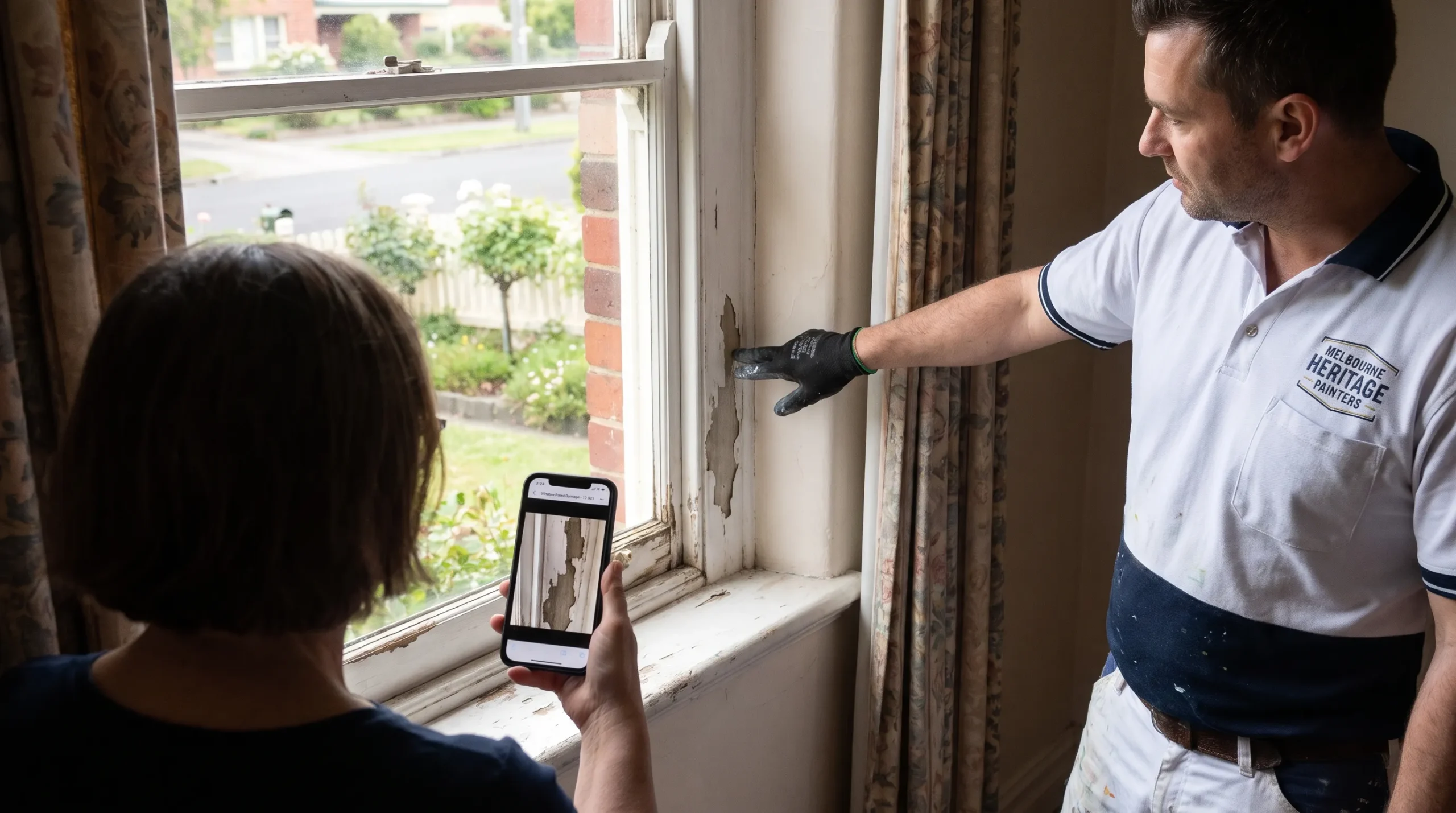
| Peeling or flaking | The surface was inadequately cleaned, prepared or primed | Whether adhesion failures caused by preparation are covered |
| Blistering | Application conditions or trapped contamination contributed to failure | How the cause will be investigated, including possible moisture sources |
| Uneven coverage | The agreed coating system was not properly applied | How missed areas or unacceptable coverage will be corrected |
| Runs, drips or heavy brush marks | Application left an unacceptable finish | Whether these are recorded and rectified at handover |
A professional painter’s warranty should describe the remedy for an accepted workmanship defect, not merely list possible failures. “We will inspect the issue” is a process step, not a commitment to repair it.
Ask whether the contractor will prepare and recoat the affected area, what costs are included and how the repaired finish will be assessed.
Make the repair scope explicit
A small patch can remain visible because of differences in sheen, texture, colour or weathering. The terms should explain whether repairs are limited to the failed patch or may extend across the affected wall or other natural boundary where needed for an acceptable result.
Also clarify who pays for labour, preparation, replacement coatings, property protection and necessary access equipment. These costs can matter more than the price of the paint, particularly on upper-storey exteriors.
Before hiring a professional painter, ask what happens if the original product is discontinued or an exact colour match is no longer possible. A sensible agreement acknowledges these limitations without making the repair obligation meaningless.
Do not assume that consequential losses, accommodation costs or business interruption are included in a voluntary warranty. Ask about them separately, while recognising that contractual exclusions do not remove rights that cannot lawfully be excluded.
Read exclusions as carefully as the cover
A painting warranty is not normally a promise that every surface will remain unchanged. Reasonable exclusions may address accidental damage, ordinary wear, building movement, ongoing water entry or work altered by someone else.
The important distinction is whether the excluded condition actually caused the failure. A reference to “moisture” should not replace an assessment of where the moisture came from and whether the preparation or application also contributed.
Ask a professional painter to explain broad exclusions such as “all cracking”, “all exterior deterioration” or “any existing surface”. Those phrases can leave substantial uncertainty about what protection remains.
Be particularly cautious if the terms appear to exclude preparation-related failures when preparation is part of the paid scope. Existing coatings can create genuine limitations, but known risks should be documented before painting, along with the proposed treatment and any agreed limits.
For example, repainting over an unstable old coating may require removal rather than another coat. If removal is excluded from the quote, you need to understand the consequences before work begins, not after the new finish lifts.
Check interior and exterior risks separately
Interior walls, bathroom ceilings, timber windows and exposed rendered walls face different conditions. Warranty wording should reflect the surfaces actually included in your job.
For interiors, clarify how cleaning damage, condensation, mould recurrence and high-traffic wear are treated. Mould can return if the moisture source remains unresolved, even after the surface has been repainted.
For exteriors, discuss water entry, timber movement, corrosion, existing coating failure and weather exposure. Melbourne’s changing conditions make suitable application windows important, but ordinary local weather should not become an unexplained blanket excuse for poor application.
Any maintenance obligations should be specific and practical. If coverage depends on regular washing or inspections, ask for written instructions covering the method and frequency. “Maintain appropriately” gives you little guidance.
Check the dates, handover and claim process
The warranty should state its duration and start date. Practical completion, final inspection and invoice payment may happen on different days, so avoid relying on assumptions.
Ask the professional painter to record outstanding touch-ups separately from defects that might appear later. Missing work should be completed as part of the agreed job, rather than left for you to pursue through a future warranty claim.
The final walkthrough is an opportunity to inspect coverage, edges, doors, windows and visible application marks. Record anything requiring attention and agree on the next step in writing. Signing a handover document does not necessarily remove rights concerning defects that were not reasonably apparent at the time.
If completion falls while you are away, perhaps on a Uganda safari with PawMac Safaris, arrange who will attend the walkthrough and how the photographs and warranty documents will reach you.
The claim process should identify a contact person or business, acceptable notification methods and what happens after you report a problem. Ask about expected inspection and repair timeframes, rather than assuming a particular response speed is guaranteed.
Keep evidence that helps establish the cause
A clear record makes it easier to distinguish coating failure from leaks, impact damage or other building problems. Keep the following together:
- The accepted quote, scope and approved variations.
- Product names, colours and sheen levels supplied for the job.
- The invoice, completion record and written warranty.
- Photographs from handover and photographs showing any later defect.
- Emails or messages reporting the issue and recording agreed action.
Report emerging defects promptly, including their location and when you first noticed them. Before allowing another contractor to repaint, give the original contractor a reasonable opportunity to inspect, unless urgent action is necessary to prevent damage or address a safety risk.
Where temporary repairs are needed, document the condition and retain relevant receipts.
Compare warranty wording, not just the number of years
A longer warranty can look attractive while offering less practical protection than a shorter, clearly defined commitment. Compare what triggers coverage, the available remedy and who bears the repair costs.
When comparing a professional painter with another contractor, read the warranty alongside the preparation specification. A promise about durability is difficult to evaluate if the quote does not identify the surfaces, repairs, primers and finishing coats involved. Our guide to what residential painting contractors include in their quotes explains the scope details worth checking.
Check the legal business name on the quote, invoice and warranty, including the ABN. You should know which business is responsible for responding to a claim, particularly where subcontractors perform the work.
Insurance and accreditation provide different information. Public liability insurance is not the same thing as a promise to rectify defective painting. Likewise, understanding what Dulux accreditation means helps you assess a contractor, but it does not replace reading that contractor’s warranty terms.
If a property sale is likely, ask whether the warranty transfers to a new owner and whether notification or other conditions apply. Never assume transferability.
Frequently asked questions
Is a five-year painting warranty enough? The period alone does not establish the value. Check the covered work, exclusions, repair costs and claim process. A clearly documented five-year commitment is easier to assess than a longer promise with uncertain conditions.
Does a professional painter’s warranty cover peeling paint? It may cover peeling caused by defective preparation or application, depending on the terms. Peeling caused by an unrelated leak or unstable substrate may be treated differently. The cause needs assessment rather than an automatic acceptance or rejection.
Does fading mean the painter must repaint? Not necessarily. Colour change can depend on the product, pigment, exposure and maintenance. Ask what appearance changes are covered and whether any relevant promise comes from the contractor, the manufacturer or both.
What if the painter rejects my claim? Request the reason in writing and ask which term and evidence support the decision. Keep your records and consider contacting Consumer Affairs Victoria for guidance if the issue remains unresolved. A voluntary warranty does not replace applicable consumer rights.
Ask for warranty terms with your quote
Auspainters provides residential and commercial painting across Melbourne, with free quotations, a five-year workmanship warranty and a final walkthrough.
When choosing a professional painter, request the written warranty before accepting the job. Confirm the preparation scope, exclusions, repair responsibilities and claim process while there is still time to clarify them.
You can request a free painting quote from Auspainters and ask for the warranty terms alongside the proposed work. That gives you a clearer basis for comparing both the finish being offered and the support behind it.