
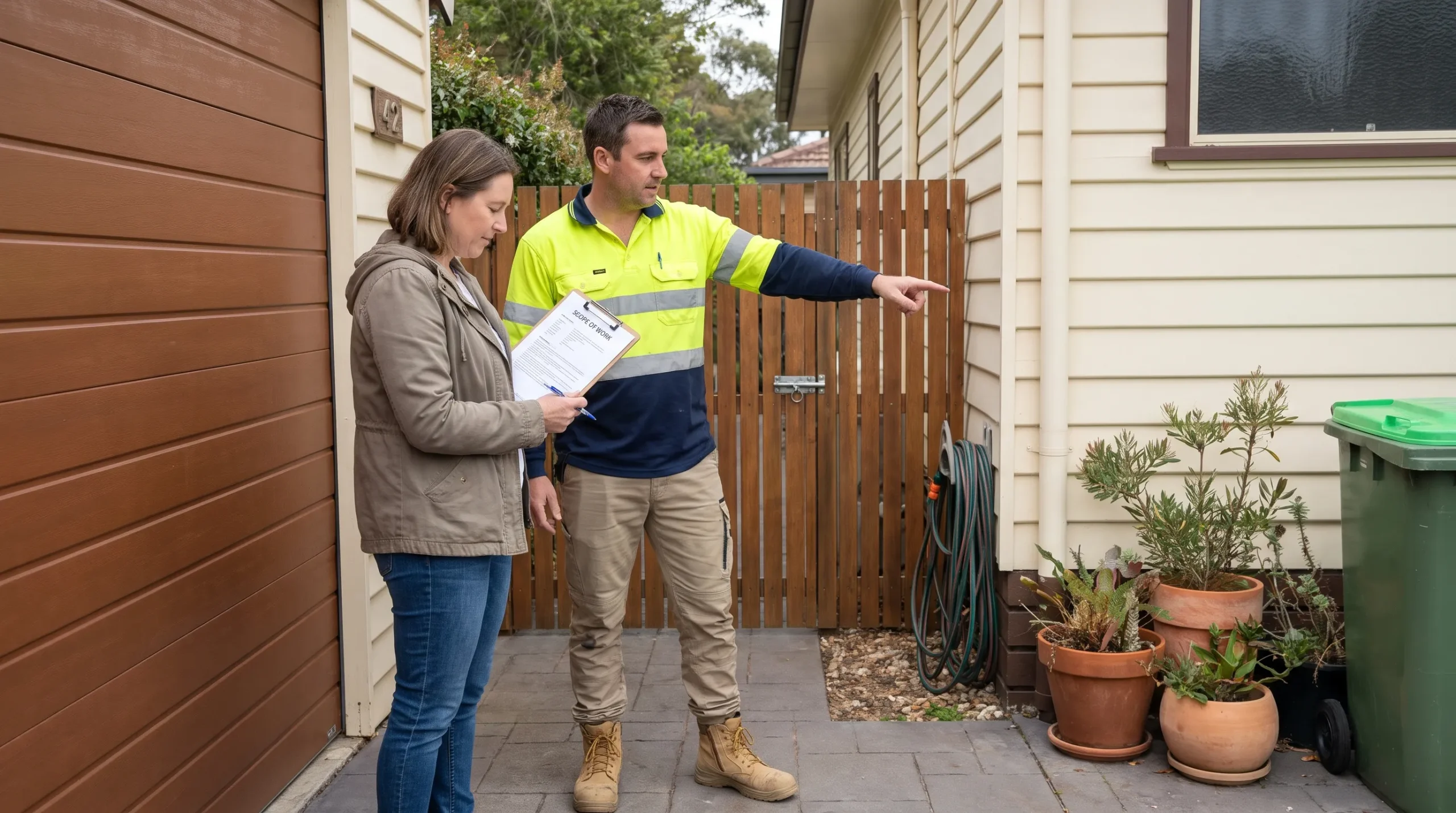

Searching for “house painting prices exterior” usually means you want to know what the whole job will cost, not just what it costs to put paint on a wall. For a Melbourne home, the biggest price changes often come from preparation, safe access and the surfaces included in the quote. Two houses with similar floor plans can require very different amounts of work outside.
The most useful budget starts with a defined scope, not a bedroom count. Before comparing totals, establish what needs painting, what condition it is in and which additional costs could arise after work begins.
Start with the exterior, not the number of bedrooms
A three-bedroom house is not a standard-sized painting job. One might have mostly unpainted brick with painted eaves and window frames. Another might have weatherboards on every elevation, a high gable and detailed timber fretwork.
Floor area also differs from paintable surface area. Long external walls, tall ceilings and complex rooflines can increase the work without adding another bedroom.
Exterior house painting prices therefore make more sense when tied to individual elevations and components. Ask whether the estimate covers walls, eaves, fascias, gutters, downpipes, doors and window frames. Decks, fences, outbuildings and roofing should be identified separately rather than assumed to be included.
Also distinguish repainting an existing coating from painting a previously unpainted surface. Preparation and product requirements can differ, particularly on masonry or metal.
Which changes have the greatest effect on the quote?
The following factors help explain why an initial allowance may differ from the price after inspection.
| Cost driver | What changes the work | What to clarify before accepting |
|---|---|---|
| Surface condition | Peeling coatings, chalking, cracks or deteriorated timber | Preparation standard and repair limits |
| Access | Upper-storey walls, steep ground or narrow side passages | Access equipment and whether its cost is included |
| Architectural detail | Numerous windows, decorative timber or intricate trims | Exactly which components will be painted |
| Coating requirements | Different substrates, staining or a major colour change | Products, primers and proposed coat system |
| Additional surfaces | Fences, garage doors, decks or detached buildings | Separate inclusions and exclusions |
| Site constraints | Restricted access, occupied outdoor areas or other trades | Working arrangements and possible extra costs |
A quote becomes easier to assess when these items are described rather than hidden inside a single “exterior painting” line.
Preparation can change after closer inspection
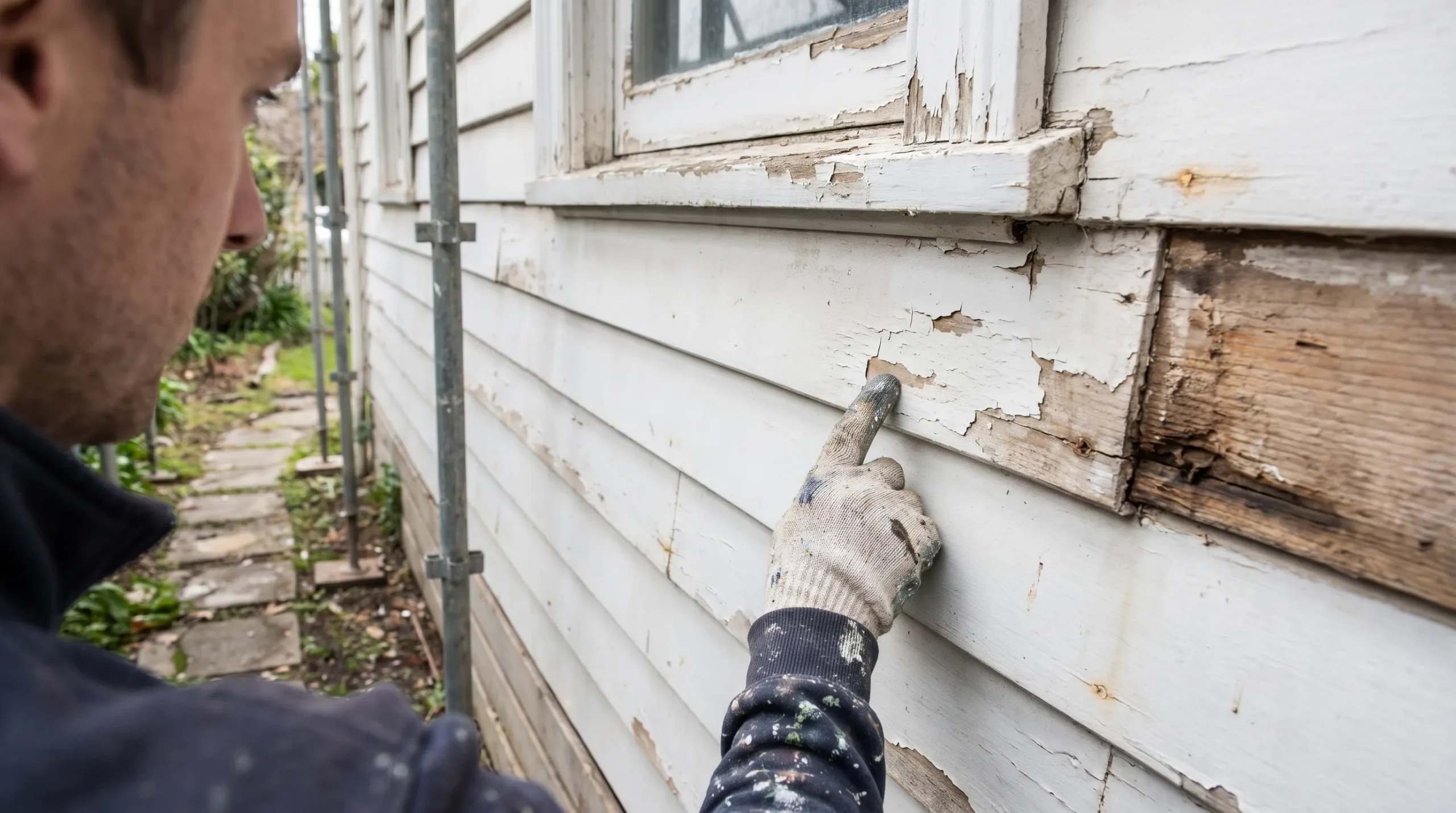
A wall can look reasonably sound from the street while having loose coating beneath the surface. Washing and careful inspection may reveal areas requiring more scraping, sanding or priming than first expected.
That does not mean every preparation task should become an extra. The quote should explain what normal preparation includes and how genuinely unforeseen deterioration will be handled.
Exterior house painting prices can rise substantially when the job changes from a maintenance repaint to extensive coating removal or timber repair. Ask whether filling minor defects is included and whether replacing damaged boards requires a separate trade or allowance.
Paint cannot fix an active leak, rotten timber or structural movement. Those causes need attention before the finish is applied. Our guide to how exterior painting protects Melbourne homes explains the relationship between sound surfaces and a protective coating.
Height and access affect more than painting time
A second storey does not simply mean twice as much paint. It can change how workers reach the surface, move materials and protect the surrounding property.
Scaffolding, an elevated work platform or other suitable access arrangements may be needed. Sloping driveways, garden beds and narrow boundaries can complicate their installation or use.
Ask whether the quoted access cost covers the expected hire period and what happens if extra repairs extend the job. Responsibility for additional hire should be clear before equipment arrives.
Avoid assuming that removing access equipment from the quote is a saving. The contractor still needs a safe method of completing the work, including preparation and inspection at height.
Coatings, colours and detail change the labour requirement
A substantial colour change may require a different preparation or coating approach to achieve even coverage. Bare timber, existing stains and metal components can also need different primers or treatments.
The same buying principle applies whether you are comparing woven cotton boxer shorts or exterior coatings: a material specification tells you more than the word “premium”. For paint, ask for the product range, intended surfaces and proposed coating system.
Exterior house painting prices also reflect application time. Several contrasting trim colours create more cutting-in and handling than a simpler scheme, particularly around small window panes or decorative timber.
Confirm how colour changes will be treated after approval. Changing your choice before materials are ordered is different from requesting a new colour after an elevation has been finished.
Beyond “house painting prices exterior”: compare the written scope
The cheapest total is only cheaper if it covers the same work. One contractor might include window frames, thorough preparation and access equipment while another has priced walls alone.
Read each quote against the same surface list. Then compare preparation, repairs, coating specifications, protection, clean-up and exclusions. Check whether the total includes GST where applicable.
For exterior house painting prices to be genuinely comparable, any provisional allowances also need to be visible. An allowance is not necessarily a fixed commitment to complete unlimited repairs for that amount.
The guide to what residential painting contractors include in their quotes provides more detail on checking the written inclusions. Use it before treating a difference in headline price as a difference in value.
A worked example of how an exterior budget changes
Consider a hypothetical homeowner who receives a $12,000 GST-inclusive quote for a defined repainting scope. After further inspection, they approve additional preparation, extra access equipment and painting a previously excluded garage door.
These figures are illustrative allowances only, not Auspainters prices or Melbourne market benchmarks.
| Item | Hypothetical GST-inclusive amount |
|---|---|
| Original agreed scope | $12,000 |
| Additional preparation approved after inspection | $1,800 |
| Additional access equipment | $1,500 |
| Garage door added to the scope | $700 |
| Revised total | $16,000 |
The increase is $4,000, but it has three different causes: newly identified work, access requirements and a homeowner-requested addition. Keeping those categories separate makes the revised price easier to check.
The lesson is not to add an arbitrary percentage to every quote. Ask what remains uncertain and attach an allowance to that specific uncertainty. A clearly identified repair risk is more useful than a vague warning that “extras may apply”.
Agree on variation rules before work starts
A variation is a change to the agreed work or price. It might arise from concealed damage, an added surface or a revised colour selection.
Before accepting the quote, agree on a simple process: the contractor identifies the issue, explains the proposed work and provides its cost and timing implications. Approval should be recorded before additional work proceeds wherever practicable.
A useful written variation identifies:
- The location and reason for the change, supported by photographs where helpful.
- The additional preparation, repair or painting work proposed.
- The price, GST treatment and any effect on the completion date.
- Who is authorised to approve it.
Exterior house painting prices are easier to control when both parties can distinguish a change from work already included. If “prepare all weatherboards” is unclear, resolve that wording before the job begins rather than during a disagreement about scraping.
Older materials need a separate safety decision
Older coatings may contain lead and some older fibre-cement components may contain asbestos. Suspected hazardous materials should not be treated as ordinary preparation work.
Do not sand, scrape or pressure-clean suspect materials yourself to reduce the quote. Arrange appropriate assessment and agree on a safe method before disturbance. WorkSafe Victoria’s asbestos guidance is a useful starting point for understanding asbestos risks.
If specialist assessment or removal is needed, clarify whether it is excluded from the painting contract and who will organise it. A lower painting quote that overlooks hazardous materials is not a reliable budget.
Reduce costs by simplifying the job, not weakening preparation
You can sometimes reduce the scope or make the site easier to work on without compromising the coating system. Clear movable furniture and garden items from agreed work areas, arrange access and finalise colours before work starts.
Ask whether sound fences or outbuildings can be left for a separate project. Simplifying a complicated trim scheme may also reduce labour, although the contractor should confirm the actual saving.
Avoid requesting fewer preparation steps simply to reach a preferred total. That changes the job’s technical requirements rather than removing unnecessary work.
The most useful savings in exterior house painting prices come from fewer surfaces, simpler detailing or better coordination. Essential surface preparation and safe access still need to be allowed for.
Separate labour hours from elapsed project time
A painting project can take longer on the calendar without requiring the same increase in labour hours. Melbourne rain, damp surfaces and unsuitable application conditions may interrupt work or extend drying periods.
Ask about the expected working days, crew size and likely elapsed duration. These are different measures. A statement such as “one week” is incomplete unless you know the assumptions behind it.
An hourly rate is also difficult to compare in isolation. It may or may not include materials, equipment, supervision or other costs. If work is charged hourly, ask for estimated hours, inclusions and an approval limit for additional time.
For a fixed-price quote, check how weather delays and equipment hire are handled. Do not assume that every wet day automatically creates an additional charge.
Frequently asked questions
How much does it cost to paint a full house outside? A reliable total requires an inspection and a defined surface list. Wall area, preparation, access and detailed trims matter more than bedroom count. The worked example above demonstrates how a budget changes, but it is not a price guide or quotation.
Is a three-bedroom house cheaper to paint than a four-bedroom house? Not necessarily. A three-bedroom weatherboard home with extensive peeling and difficult access may require more work than a larger brick home with relatively little painted trim.
How many hours does it take to paint a four-bedroom house exterior? Bedroom count cannot establish labour hours. Ask for an estimate based on measured surfaces, preparation, access and the proposed coating system. Also distinguish total crew hours from the number of days on site.
What should I ask about an hourly painting rate? Check whether it applies per painter, whether GST is included and which materials or equipment are charged separately. Exterior house painting prices based on hourly work need a clear scope and approval process just as fixed-price jobs do.
Does a workmanship warranty remove the need to check the quote? No. You still need to understand the included surfaces, preparation and products. Ask for the warranty terms and how they apply to the agreed work.
Get a quote based on your home’s actual condition
Auspainters provides exterior painting across Melbourne, with free quotations, Dulux accreditation, full insurance and OHS-compliant workmanship. Its service includes a final walkthrough and a 5-year workmanship warranty.
Request a free quote from Auspainters and identify the surfaces you want included. Ask for preparation, access requirements and any repair allowances to be set out clearly so you can assess the total before work begins.