

A fresh coat can make almost any home look better, but quality house painting is judged by what happens after the painter leaves. The finish should remain well bonded, cope with everyday use and protect the surface beneath it. Smooth walls and neat edges matter, but they cannot compensate for trapped moisture, unsuitable primers or rushed drying times.
For Melbourne homeowners, durability comes from matching the preparation, coating system and application conditions to the property. A shaded weatherboard wall has different demands from a sunny rendered façade or a busy kitchen. Understanding those differences helps you recognise good work before problems appear, rather than relying on colour, price or the word “premium”.
How quality house painting holds up over time
A lasting paint job performs in three ways: it adheres to its substrate, forms a suitable protective film and remains practical to maintain. Those qualities are related, but they are not interchangeable.
Paint can look even while sitting over a dusty surface that weakens adhesion. A hard-wearing enamel can still fail on timber with an unresolved moisture problem. An attractive matt finish may also be unsuitable for a wall that needs frequent cleaning.
The useful distinction is between appearance at handover and performance in service. At handover, you can assess coverage, colour consistency and workmanship. Longer-term performance depends heavily on decisions made before the final coat went on.
There is no universal lifespan for every painted surface. Exposure, substrate condition, product selection and maintenance all affect the outcome. Quality house painting reduces avoidable failures, but it does not make a building maintenance-free or stop structural movement.
Sound surfaces come before smooth finishes
Resolve the cause of damage
Blistering, peeling and staining are symptoms, not a preparation plan. Before repainting, the underlying cause needs attention. Possible problems include leaking gutters, failed window seals, damp masonry or deteriorated timber.
Painting over a stain without resolving the leak may hide the evidence briefly. Likewise, filling softened timber does not restore its structural condition. Repairs may need to happen before the painting work can proceed.
Melbourne homes can have very different exposure conditions on opposite sides of the same building. The principles behind how exterior painting protects Melbourne homes help explain why moisture control and protection should be assessed surface by surface.
Prepare for adhesion, not just appearance
Preparation usually involves cleaning, removing unsound coatings, treating relevant contamination and smoothing repairs. The exact work depends on the substrate and existing finish. Glossy surfaces may require abrasion or an appropriate bonding system, while bare patches may need a compatible primer.
Quality house painting starts with a surface that is sound, clean and ready for the specified coating, rather than simply one that looks tidy from a distance.
Older homes may contain lead-based paint. Suspect coatings should be assessed before disturbance, with appropriate controls used for removal or preparation. Uncontrolled dry sanding is not a safe shortcut.
The coating system matters more than the paint label
“Premium paint” describes only part of the job. A coating system includes any required primer, sealer or undercoat, followed by compatible finishing coats. Each layer has a purpose, and the requirements vary between substrates.
The following examples show why one approach cannot suit every surface:
| Surface or condition | What the coating system needs to address | What can go wrong if overlooked |
|---|---|---|
| Bare or repaired plaster | Absorbency and differences between repaired and existing areas | Uneven sheen or visible patches |
| Previously painted glossy trim | Adhesion to the existing coating | Chipping or peeling |
| Exterior timber | Exposure, timber condition and coating compatibility | Early breakdown or loss of adhesion |
| Render or masonry | Surface condition, moisture and suitability for the substrate | Blistering, flaking or recurring stains |
| Metal components | Metal type, corrosion and compatible preparation | Rust staining or coating failure |
These are assessment categories, not universal product prescriptions. The painter should select the system using the actual surface condition and the manufacturer's current technical guidance.
For example, Dulux’s product information can help homeowners understand coating options, but the relevant product data sheet is where application limits and preparation requirements should be checked.
Quality house painting uses compatible layers and the specified coverage, rather than assuming an expensive topcoat will overcome problems underneath.
Application conditions determine whether the system performs
Coverage is not the same as protection
A coat can hide the previous colour without providing the film build specified for that product. Stretching paint too far may achieve visual coverage while leaving less material on the surface than intended.
Conversely, applying paint too heavily can create runs or interfere with drying. The aim is not the thickest possible coat, but the manufacturer's recommended application rate and coating sequence. Extra coats should address the system requirements, colour change or coverage, not replace proper preparation.
Drying time and curing time are different
Touch-dry paint is not necessarily ready for another coat, vigorous cleaning or normal wear. Recoat intervals and full curing requirements vary with the product, temperature, humidity and ventilation.
Exterior work also depends on surface conditions. A wall may be damp from overnight condensation even when no rain is falling. Direct sunlight can heat a surface beyond suitable application conditions, while cool, humid weather can slow drying.
Quality house painting allows the work schedule to follow the coating requirements, rather than forcing the coating to suit a fixed completion date.
Inside the home, newly painted doors, windows and trim also need suitable drying time before contact or closure. Rushing this stage can leave impressions or cause painted surfaces to stick together.
The right finish suits how the room is used
Sheen is not only a design choice. It affects how light reveals imperfections and how a painted surface behaves during cleaning. Many higher-sheen coatings tolerate cleaning well, but washability depends on the product formulation too. Some purpose-designed matt paints are washable.
Bedrooms, hallways and laundries have different demands. A hallway may need resistance to repeated wiping, while bathroom coatings need to suit the expected humidity. Paint does not replace adequate ventilation or fix an ongoing mould problem.
A dental practice such as The Dental Lounge Robina illustrates a setting where cleanability belongs in the design brief. Homes have different cleaning requirements, but the same selection principle applies: match the finish to the way the space will actually be maintained.
Quality house painting balances appearance with use, so homeowners are not left with a beautiful surface that becomes difficult to care for.
Colour and lighting still matter. Test patches help reveal how a chosen colour and sheen look in the room's daylight and artificial light, particularly across large walls or near windows.
What to check at the final walkthrough
A final walkthrough should assess more than whether the colour is correct. View the work in normal daylight and under the lighting used in each room. Very harsh side lighting can exaggerate minor substrate variations, so expectations about existing wall imperfections should be agreed before work starts.
Useful checks include:
- Consistent coverage: Look for thin areas, missed edges and visible differences around repairs.
- Controlled application: Check for runs, drips, obvious lap marks and excessive roller or brush texture.
- Clean junctions: Inspect where walls meet ceilings, trim, fittings and adjacent unpainted surfaces.
- Practical operation: Confirm that painted doors and windows operate correctly once sufficiently dry.
- Site condition: Check that masking has been removed and unintended paint marks have been addressed.
Some features are harder to verify after completion. Preparation, primer selection and recoat intervals are largely hidden by the finished surface. Progress photographs and a written record of the products used can help document those stages.
Quality house painting should leave you with both an acceptable finish and clear information about how to care for it.
Before work begins, it is worth understanding what residential painting contractors include in their quotes. A documented scope gives the walkthrough a useful reference point and helps distinguish agreed work from additional repairs.
Maintenance protects the result
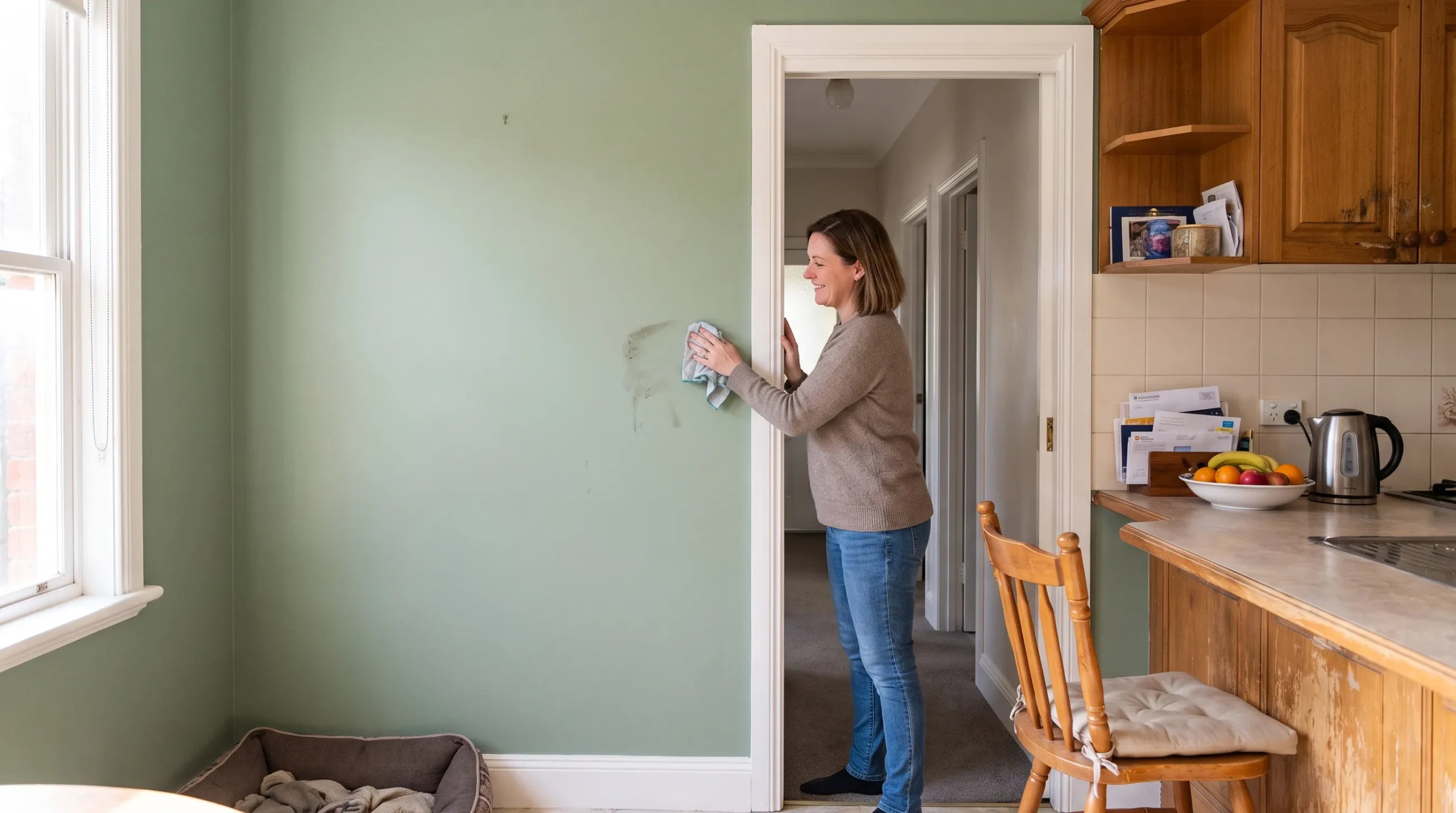
Once the coating has cured as directed, use the manufacturer's recommended cleaning method. Start gently and avoid abrasive pads or strong chemicals unless they are specifically suitable for the product. Repeated scrubbing can alter sheen or damage the surface even when the paint is washable.
Outside, routine building maintenance is just as important as paint care. Keep gutters and drainage working, address leaks promptly and look for early signs of cracking, exposed timber or failed joints. Vegetation resting against walls can also hold moisture or rub against the coating.
Touch-ups are not always invisible. Differences in application, sheen and weathering may show, particularly on broad walls under directional light. Retaining the product name, colour formula and finish makes future maintenance easier, although repainting to a natural boundary may still be necessary.
Quality house painting lasts best when small defects are addressed before water or weather can enlarge them.
A workmanship warranty provides another point of accountability, but it is not a substitute for maintenance. Ask for its written terms, including what is covered, what is excluded and how a concern should be reported. Do not assume it covers every future mark, leak or building movement.
Frequently asked questions
How long should a professionally painted house last? There is no single reliable figure for every home. Interior wear, exterior exposure, surface condition and the coating system all influence repainting needs. Ask for expectations specific to your property rather than a blanket lifespan promise.
Does expensive paint guarantee a lasting finish? No. A suitable, well-formulated coating matters, but it still needs sound preparation, compatible underlying layers and correct application. Premium paint cannot repair damp surfaces or secure loose existing coatings.
Are two coats always enough? Not necessarily. The required system depends on the product, substrate, colour change and existing finish. Primers or undercoats may also be needed. Follow the specified coating system rather than treating a fixed coat count as proof of quality.
How can I judge workmanship before long-term problems appear? Quality house painting is supported by an explained preparation process, a suitable coating specification and a thorough final inspection. Written records help you assess work that becomes hidden beneath the finish.
Arrange a property-specific assessment
Auspainters provides interior and exterior residential painting across Melbourne, with free quotations, premium finishes and a final walkthrough. The team is Dulux accredited, fully insured and OHS compliant, and offers a 5-year workmanship warranty.
To discuss your home's surfaces, existing coating condition and intended finish, request a free quote from Auspainters. A property-specific assessment is the right starting point for a paint job designed to perform beyond the first impression.